How to Know When Your Website Needs a Redesign (vs. a Refresh)
How do I know if I need a website redesign or just a refresh?
A website refresh updates the visual design, content, or user experience without changing the underlying structure or strategy. A website redesign rebuilds the site from the ground up, including strategy, architecture, platform, and content. You need a redesign if your business has fundamentally changed, your platform limits what you can do, the site is not converting at all, or the structure is too complicated. You need a refresh if the foundation is solid but the presentation is dated, the messaging is slightly off, or the site works but could perform better.
One of the most common questions I hear from Gen-X women entrepreneurs is some version of: "I know my website needs work, but I do not know if I need to start over or just fix what I have."
It is a good question, and the answer matters more than you might think.
A website redesign and a website refresh are different projects with different costs, timelines, and outcomes. Choosing the wrong one can waste thousands of dollars and months of effort. Choosing the right one can transform your website from a digital brochure into a business asset that actually converts visitors into clients.
The difference comes down to whether the foundation underneath your website is still sound or whether the entire structure needs to be reimagined.
What Is a Website Refresh?
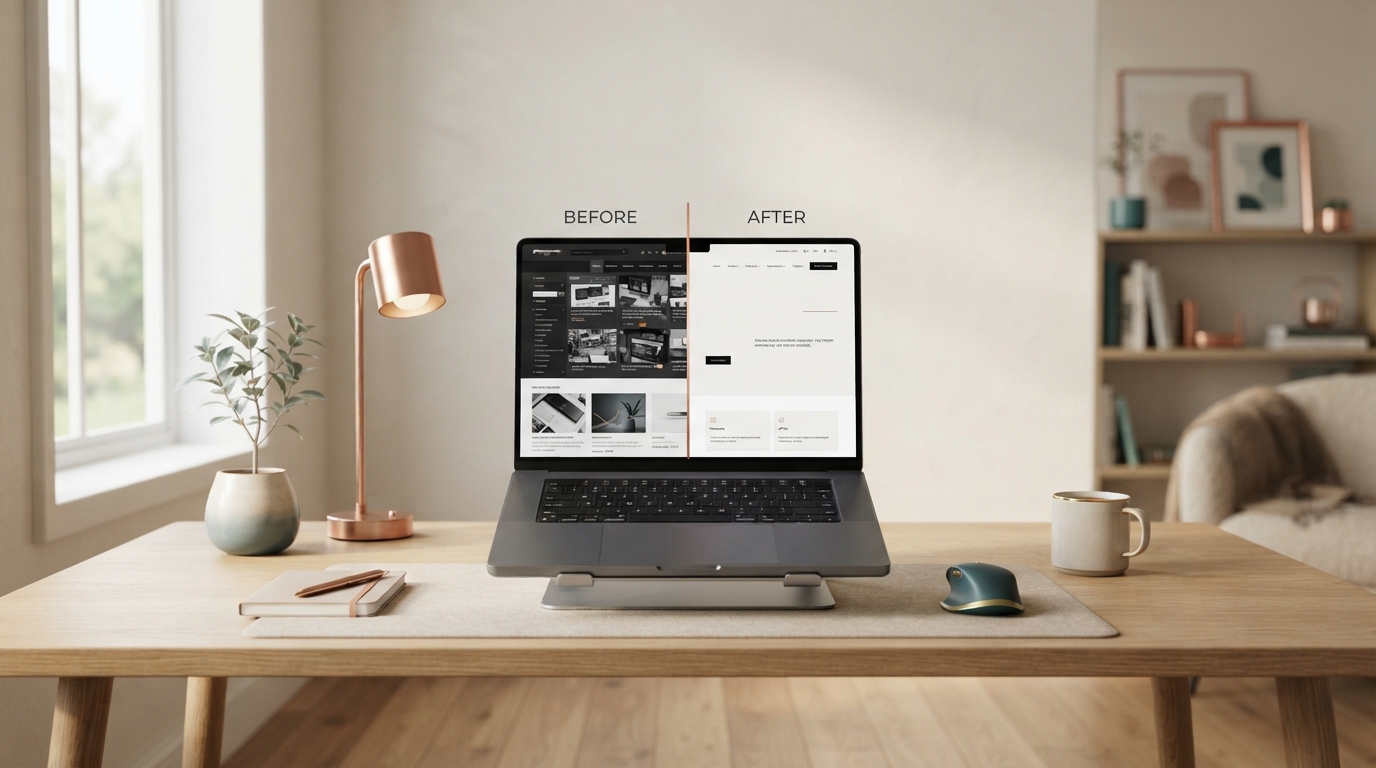
A website refresh means updating the visual design, content, or user experience of your existing website without changing the underlying structure, platform, or strategy. Think of it as renovating the interior of a house while keeping the foundation, walls, and layout intact.
A refresh might include updating fonts and colors, replacing outdated photos, rewriting copy, improving mobile responsiveness, adding new pages, or reorganizing existing content. The website stays on the same platform, uses the same basic architecture, and serves the same fundamental purpose.
A refresh is appropriate when the foundation is solid but the presentation has become dated, unclear, or misaligned with where your business is now.
What Is a Website Redesign?
A website redesign means rebuilding the site from the ground up. This may involve changing platforms, restructuring the entire site architecture, rethinking the strategy, creating new offers and pathways, and fundamentally changing how the website functions as part of your business.
A redesign is a larger investment, but it is necessary when the existing website's foundation can no longer support what the business needs. This might be because the business has changed direction, the platform is too limited, the structure is too complicated, or the strategy underneath the design was never clear enough to convert visitors in the first place.
A redesign is not just about making the site look better. It is about making the site work differently.
Signs You Need a Website Refresh
A refresh may be the right choice if your website's foundation is sound but the surface needs updating. Here are signs that a refresh is sufficient.
Your business has not fundamentally changed. You still serve the same audience, offer the same core services, and have the same basic business model. The website just does not reflect the current version of that work as clearly as it could.
The design looks dated. The fonts, colors, layout, or photography feel like they belong to an earlier era of your business. The content is still relevant, but the presentation undermines your credibility.
The messaging is slightly off. Your offers have evolved, and the website copy does not quite match how you currently describe your work. A rewrite would solve the problem without rebuilding the site.
The site works on mobile but could be better. The website is technically responsive, but the mobile experience is not as smooth as it should be. Some formatting adjustments and layout improvements would fix the issue.
You are getting some inquiries but not enough. The website is functioning, but it could perform better. Improving the calls to action, adding trust-building content, and clarifying the next steps would likely increase conversions without a full rebuild.
In these cases, the strategy is basically right. The execution just needs polishing.
Signs You Need a Website Redesign
A redesign becomes necessary when the problems with your website are structural, not cosmetic. Here are the signs that a refresh will not be enough.
Your business has changed direction. You have shifted your audience, your offers, or your entire business model. The website was built for a previous version of the business, and no amount of copywriting will make it fit the current one.
The website cannot do what you need it to do. You want to add interactive tools, membership areas, course platforms, booking systems, or AI-powered features, and your current platform cannot support them. The technology is the limiting factor.
The structure is too complicated. The site has grown organically over years, accumulating pages, offers, and sections that no longer connect logically. Visitors get lost. You get lost. The site needs to be restructured from the ground up, not tidied.
The website is not converting at all. You are getting traffic but virtually no inquiries, sign-ups, or sales. As I wrote in Why Your Website Isn't Converting Visitors Into Clients, this is usually a strategy problem, not a design problem. If the strategy is fundamentally broken, a new coat of paint will not fix it.
You are embarrassed to share the link. If you hesitate to send people to your website because you know it does not represent your business well, the problem has moved beyond a refresh. The site is actively working against you.
The platform is holding you hostage. You cannot make simple changes without paying someone, the loading speed is terrible, the SEO capabilities are limited, or the platform is shutting down. The technology itself has become a liability.
In these cases, the foundation is the problem. A refresh would be like painting over water damage. It might look better for a while, but the structural issue remains.
The Strategic Question Behind the Decision
The choice between a refresh and a redesign is not really about the website. It is about the business.
Before deciding which approach to take, ask yourself whether your business strategy is clear. Do you know who you serve, what problem you solve, what makes your approach different, and what the visitor should do next? If the answer is no, neither a refresh nor a redesign will solve the problem until the strategy is defined.
This is why I always start with strategy before touching design. A beautiful website built on an unclear strategy will fail just as surely as an ugly one. The difference is that it will cost more.
If the strategy is clear and the website just needs to catch up, a refresh may be enough. If the strategy has changed and the website needs to reflect a different business, a redesign is the right path.
What About AI? How AI Changes the Redesign Question
AI is changing what websites need to do, and it is also changing how we build them. If your website was built before AI became a factor in search and content discovery, it may need more than a refresh to remain competitive.
AI-powered search engines are looking for clear, authoritative, well-structured content. They want to understand who you are, what you do, and why your perspective matters. If your website is vague, fragmented, or outdated, AI tools will struggle to recommend you—even if the design looks fine.
This does not mean every website needs a full redesign because of AI. But it does mean that your content strategy, site structure, and messaging need to be clear enough for both humans and AI to understand. If they are not, that is a strategic redesign, even if the visual design stays the same.
Cost and Timeline Considerations
A website refresh is typically faster and less expensive than a full redesign. It might take a few weeks and involve updating existing content, refreshing the design, and improving specific pages.
A website redesign is a larger investment of time and money. It involves strategy, architecture, design, development, content creation, and testing. It may take several weeks to several months depending on the scope.
But cost should not be the deciding factor. The deciding factor should be whether the current website can serve the business you are building. If it cannot, spending money on a refresh is more expensive in the long run because it delays the real work while giving the illusion of progress.
I have seen women spend thousands on refreshes year after year, avoiding the redesign they actually needed, and end up spending more than a redesign would have cost in the first place. The website never quite works, and the frustration accumulates.
What a Redesign Should Include
If you decide a redesign is the right path, the project should include more than design. A proper redesign addresses strategy, structure, content, technology, and conversion.
Strategy: Clarifying who you help, what you offer, what makes you different, and what the visitor should do next. This is the foundation everything else is built on.
Architecture: Structuring the site so the path through it is clear. Every page should have a purpose, and every page should connect logically to the next.
Content: Writing copy that communicates clearly, builds trust, and moves the visitor toward action. This includes SEO-optimized content that both humans and AI can understand.
Design: Creating a visual experience that reflects your brand, builds credibility, and supports the strategy rather than competing with it.
Technology: Choosing a platform that can support what the business needs now and in the future, including AI integration, interactive tools, and scalable content.
Conversion: Building clear calls to action, email capture, follow-up sequences, and analytics so the website actively contributes to business growth.
If any of these pieces is missing, the redesign will underperform. This is why I approach websites holistically through The Business Blender—because a website is not just a design project. It is a business strategy project.
What a Refresh Should Include
If a refresh is the right choice, it should still be strategic, not just cosmetic.
Copy review: Read every page and ask whether the messaging is current, clear, and compelling. Update anything that feels stale or vague.
Visual update: Refresh fonts, colors, photography, and layout to align with your current brand. Make sure the site looks professional on both desktop and mobile.
Call to action audit: Make sure every page has a clear next step. Remove competing options and simplify the path.
Content gaps: Add any missing pages, FAQs, or resources that would help visitors understand your work and take action.
Performance check: Test loading speed, mobile responsiveness, and broken links. Fix anything that creates friction.
A well-executed refresh can add years of life to a website that still has a solid foundation.
The Decision Framework
If you are still unsure, here is a simple framework.
Ask: Has my business fundamentally changed since this website was built? If yes, you likely need a redesign. If no, a refresh may suffice.
Ask: Is the website's platform limiting what I can do? If yes, redesign. If no, refresh.
Ask: Is the website converting visitors into clients? If it is converting but could do better, refresh. If it is not converting at all, redesign.
Ask: Can I explain what my website does for my business in one sentence? If yes and the site reflects it, refresh. If no, you need strategy first—then decide.
The right answer is not about what is trendy or what someone on the internet told you to do. It is about what your business actually needs to grow.
Your Website Is Your Most Important Business Asset
Your website is the one piece of digital real estate you actually own. Social media platforms change their rules. Email algorithms shift. AI tools evolve. But your website is yours, and it should work for your business every single day.
Whether you need a refresh or a redesign, the goal is the same: a website that clearly communicates who you help, builds trust with the right people, and makes it easy for them to take the next step.
If you are not sure which one you need, that is exactly what I help women figure out. Through The Business Blender, I help Gen-X women entrepreneurs evaluate their websites, clarify their strategy, and build digital experiences that actually convert.
Bring me the mess. We'll blend it into a website that works as hard as you do.
About Heidi Totten
Heidi Totten is a business strategist and technology leader who helps Gen-X women entrepreneurs build websites that convert, businesses that simplify, and systems that sustain. After more than 30 years in technology and entrepreneurship, she writes about website strategy, AI, business systems, and the practical decisions that help experienced women create more impact without creating more chaos.